
Key Takeaways:
- Residential HVAC systems typically serve one home with predictable occupancy, while commercial HVAC systems may serve multiple zones, tenants, or operating schedules.
- Equipment differs sharply. Homes rely on split systems, heat pumps, and central air. Commercial buildings often run rooftop units, packaged systems, or VRF setups.
- The size of the job doesn’t decide the price. Access, diagnostic complexity, and parts availability matter just as much as square footage.
“The AC isn’t cooling.” Sounds like one problem, right? A homeowner in Weston Hills says it. An office manager in a Weston Commons strip mall says it. A restaurant owner near Bonaventure Country Club says the exact same five words. But what happens after that sentence leaves their mouth can look nothing alike, and that gap is the whole reason this article exists.
Here’s the short version, since you probably want the answer before the explanation: residential and commercial HVAC repair both involve heating, cooling, and moving air, but the equipment, the controls, access to the unit, and the consequences of a breakdown are often completely different animals. A technician who’s spent a decade perfecting split-system and central-air repairs for homeowners looking for HVAC repair Weston Services isn’t automatically ready to climb onto a rooftop packaged unit above a commercial kitchen. That’s not a knock on residential techs. It’s just a different trade skill, built around different equipment, controls, and repair requirements than residential techs. It’s just a different trade skill, built on different equipment logic.
Is commercial HVAC repair always more expensive than residential repair?
Question: Is commercial HVAC repair always more expensive than residential repair?
Answer: Not necessarily. A straightforward commercial thermostat or control board fix can cost less than a major residential compressor or expansion valve replacement. Cost follows complexity and access, not the label on the building.
The Biggest Difference: Residential and Commercial HVAC Systems Are Built for Different Jobs
A home in Weston generally needs one HVAC system (maybe two if it’s a larger property) working against a fairly predictable pattern. People wake up, people leave for work, people come home, and the thermostat cycles through a routine that barely changes week to week. For homeowners looking for HVAC repair in Weston FL, that typically means troubleshooting a system designed around one household’s comfort needs.
Commercial buildings don’t get that luxury. An office tower, a retail strip, a restaurant kitchen, a warehouse, a school—these all carry wildly different occupancy loads, ventilation demands, and operating hours, sometimes under one roof.
That’s the part people miss. Commercial doesn’t just mean “a bigger version of what’s in my attic.” A commercial HVAC system often has to account for conditioned square footage spread across multiple tenants, variable occupancy during business hours, multiple temperature zones, fresh-air ventilation requirements for public spaces, and specialized environments like server rooms or cold storage. None of that exists in a typical single-family install. The engineering logic underneath a commercial rooftop unit is built around flexibility and capacity planning, not just raw BTU output.
| Factor | Residential HVAC | Commercial HVAC |
|---|---|---|
| Typical setting | Single-family homes | Offices, retail, restaurants, warehouses |
| Occupancy pattern | Predictable, routine | Variable, multi-tenant |
| Zoning | One or few zones | Multiple zones common |
| Ventilation needs | Standard | Often code-driven, higher volume |
6 Ways Residential and Commercial HVAC Repair Differ
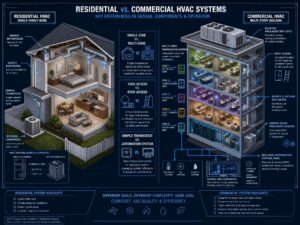

1. Commercial HVAC Systems Often Have More Zones and Controls
In a house, “it’s not cooling” usually points to one unit and a short list of suspects. In a commercial property, that same complaint might trace back to a thermostat glitch, a stuck zone damper three floors up, a bad sensor, a communication fault between the building automation system and the rooftop unit, or an actual equipment failure. Technicians sometimes have to treat the whole setup as a network rather than a single appliance, which changes how long diagnostics take and what tools get pulled out of the truck.
2. Access and Physical Location Can Change the Repair
Residential equipment tends to live somewhere predictable: an attic, a garage, a closet, or a pad outside. Commercial units often sit on rooftops, tucked into mechanical rooms, hung above drop ceilings, or behind locked doors that require coordination with building management. Rooftop access alone can mean ladders, fall protection, and scheduling around a landlord’s hours. None of that reflects how hard the actual repair is. It just adds time, and time is money in this trade.
3. A Commercial HVAC Breakdown Can Affect Business Operations
When a home’s air conditioner dies on a brutal August afternoon in Broward County, it’s uncomfortable and it needs fixing fast, but it’s mostly a comfort issue. When a commercial rooftop unit dies above a restaurant kitchen or an office floor, the fallout spreads to employees, customers, inventory, sometimes even sensitive equipment that needs stable temperatures to function.
The real cost of commercial HVAC downtime isn’t always the repair bill. It’s the lost revenue, spoiled inventory, or frustrated tenants stacking up while the clock runs.
That’s why commercial service calls sometimes prioritize a temporary fix to keep the space functional, followed by a more thorough repair scheduled around business hours.
4. Troubleshooting May Require Different Tools and Expertise
Commercial systems can involve larger electrical components, advanced control boards, economizers, variable-speed compressors, and building automation integration that a typical residential call never touches. A technician walking into that environment needs familiarity with the specific equipment, not just a general HVAC background.
Before hiring, it’s fair to ask a contractor:
- What types of commercial systems do you regularly service, and do you have experience with this specific brand or model?
- Can you handle both equipment-level repairs and building automation or control issues?
- Do you offer emergency response for commercial properties, and what’s your typical turnaround?
- How do you document diagnostic findings for facility records?
5. Repair Costs Are Influenced by More Than System Size
It’s tempting to assume commercial repairs always cost more because the equipment looks bigger. That’s a misconception worth correcting. A straightforward commercial control board swap might run cheaper than a major residential compressor failure. What actually drives the bill is parts availability, labor complexity, access difficulty, how many components are affected, required safety procedures for rooftop or confined-space work, and how urgently the fix is needed.
6. Maintenance and Repair Planning Can Be More Structured for Businesses
Homeowners tend to call when something breaks. Businesses, especially ones managing multiple units across a property, often shift toward scheduled preventive maintenance instead, partly because unplanned downtime costs more than a maintenance contract ever would. That means coordinated inspections, documented equipment history to track recurring issues, and repairs scheduled around operating hours rather than whenever a technician happens to be free. Preventive maintenance doesn’t eliminate surprise breakdowns, according to guidance from ENERGY STAR’s maintenance checklist, but it does catch a worn coil or a flagging expansion valve before it turns into an emergency.
Can a Residential HVAC Technician Repair a Commercial System?
Sometimes, yes. It really comes down to the individual technician’s training, licensing, hands-on experience, and familiarity with that specific equipment category not whether their business card says “residential” or “commercial.” A technician who regularly handles residential AC repair in Weston, FLmay have extensive experience with home comfort systems, but that doesn’t automatically mean they’re equipped to diagnose a large rooftop unit, complex zoning system, or commercial controls. Treating those labels as the only qualification filter is a mistake plenty of property owners make, usually right before a bigger mistake.
A good contractor should clearly explain which commercial systems they service, whether they’ve worked on your equipment type, how they diagnose multi-zone systems, and whether they handle emergency calls or building automation. For specialized equipment like chillers or VRF systems, ask for recent examples. The goal isn’t a “commercial” label it’s proven, equipment-specific expertise, something Airfellows and other trusted local HVAC companies can demonstrate through their track record and customer satisfaction.
Verifying active licensing isn’t optional window dressing either. Florida homeowners and business owners can confirm a contractor’s mechanical license status directly through the state’s DBPR license search system, which takes about thirty seconds and saves a lot of regret later.
When a Commercial HVAC Problem Needs Specialized Attention
Certain warning signs suggest a situation has outgrown routine troubleshooting. Multiple zones acting up at once, a rooftop unit that keeps failing despite repeated repairs, building controls that won’t communicate properly, recurring refrigerant or airflow problems, or a specialty environment (like a server room or medical storage area) losing climate stability all point toward bringing in someone with deeper commercial expertise. None of these automatically mean catastrophic failure. They mean the diagnostic approach needs to widen beyond “check the one indoor unit.”
How to Choose the Right HVAC Repair Contractor

This is where the research pays off. Ask whether the company regularly services the type of system installed in your building, confirm that its licensing and insurance are current, and ask about experience with your equipment’s manufacturer and model. For businesses, find out whether repairs can be scheduled around operating hours to minimize disruption.
Look for a contractor that explains the diagnosis clearly, shows you what’s actually failing, and recommends repairs based on the condition of your system not a hard sell. Airfellows takes this straightforward approach, helping property owners understand the problem and their repair options before moving forward.
When choosing a commercial HVAC contractor, look for an established team with properly trained and credentialed technicians, relevant equipment experience, and a track record of reliable service. This matters even more when a system fails during extreme weather or outside normal business hours, when fast and accurate diagnostics can help minimize disruption. At Airfellows, experienced technicians can assess the issue, explain the recommended repair, and help businesses make informed decisions about their HVAC systems without unnecessary delays.
Avoid choosing purely on lowest quoted price. A rock-bottom estimate that skips the diagnostic explanation is usually the one that turns into a surprise invoice.
Residential vs. Commercial HVAC Repair: Quick Comparison
| Factor | Residential HVAC Repair | Commercial HVAC Repair |
|---|---|---|
| Typical setting | Homes | Offices, retail, industrial, multi-unit properties |
| Equipment | Split systems, heat pumps, furnaces, mini-splits | Rooftop units, packaged systems, VRF/VRV, chillers |
| System complexity | Often one system or a few zones | Multiple zones, units, and controls |
| Access | Attic, garage, basement, exterior pad | Roofs, mechanical rooms, restricted areas |
| Impact of failure | Occupant comfort | Operations, employees, customers, inventory |
| Service planning | Appointment-based | Scheduled around business hours |
| Contractor expertise needed | Residential system experience | Relevant commercial equipment and controls experience |
Contact AirFellows fir HVAC Repair Services in Weston
AirFellows works on both residential and commercial systems, with a Broward office right here in Weston. Our licensed, insured technicians (Florida License #CAC1823273) diagnose the problem first and explain your options before any work begins.
- Homeowners: Schedule AC repair in Weston for central AC, ductless mini-splits, and heat pumps.
- Business owners: Learn about our commercial and restaurant AC repair in Weston, built to keep downtime to a minimum.
- Ready to talk now? Contact our Broward team!
Frequently Ask Questions
Does Weston, Florida weather make HVAC systems work harder than in other regions?
Yes. South Florida’s humidity and near-constant cooling demand mean HVAC systems throughout Weston and neighboring Palm Beach and Broward County areas run longer duty cycles than systems in milder climates, which speeds up wear on components like compressors and expansion valves.
How often should a central air system get professional maintenance in Weston?
Most manufacturers and energy guides recommend at least one seasonal tune-up annually, though South Florida’s heavy cooling season often makes twice-yearly checks a smarter call for catching coil and drain issues early.
Are air duct cleanings usually necessary for homes in Weston?
Not always. According to the EPA’s guidance on air duct cleaning, routine cleaning is rarely needed unless there’s visible mold growth or pest infestation, so be cautious of anyone upselling it without evidence.
Can upgrading to a higher-efficiency AC unit qualify for rebates in Florida?
Possibly. FPL’s instant rebate program offers homeowners savings on qualifying high-efficiency installations, with specifics outlined in FPL’s residential AC rebate program.
What’s the difference between a home’s heat pump and a commercial rooftop unit?
A residential heat pump handles both heating and cooling for one home through a single outdoor and indoor unit pairing, while a commercial rooftop unit often serves multiple zones at once and may integrate with building-wide automation controls, making diagnostics considerably more involved.
Read More Articles
HVAC in Weston, FL: AC Repair, Installation and Maintenance for Broward Homes
Best AC Repair Specialists in Weston, FL: How to Tell a Real Pro From a Truck With a Logo
Best AC Installation Company in Weston, FL: What Separates a Correct Install From a Cheap One
Same-Day AC Repair in Weston, FL: What ‘Same Day’ Actually Means on Our Schedule
Emergency AC Repair in Weston, FL: After-Hours, Weekends and Holidays
Same-Day AC Installation in Weston, FL: Replace a Dead System Without Losing a Night
Residential AC Installation in Weston, FL: How We Size a System for Your Home
Affordable AC Installation in Weston, FL: Financing, FPL Rebates and Flat-Rate Quotes
Hiring an HVAC Company in Weston, FL: License, Insurance and the Five Questions to Ask
Commercial and Restaurant AC Repair in Weston, FL: Keeping the Doors Open
Book AC Repair and Maintenance Together in Weston, FL: One Visit, Two Jobs
How Much AC Repair Costs in Weston, FL: 2026 Price Ranges by Failure Type
AC Repair or Replace? A Decision Framework for Weston AC Systems Over 10 Years Old
What Happens During an AC Installation in Weston, FL: The Full Day, Step by Step
What’s Included in AC Installation Services in Weston, FL — and What Gets Quietly Left Out
Mini-Split vs Central AC for Weston Homes: Additions, Garages and Older Layouts
Are AC Maintenance Plans Worth It in Weston, FL? Running the Actual Numbers
What a Full AC System Maintenance Visit Covers in Weston, FL: The 21-Point List
Choosing an AC Maintenance Service Near You in Weston, FL: Frequency, Timing and Cost
Furnace Repair or Furnace Replacement in Weston, FL: Heat Strips, Heat Pumps and Real Failures
Heating Maintenance and Installation in Weston, FL: What South Florida Homes Actually Need
Your AC Is Running but the House Is Still Hot — Here’s What That Means
Water Pooling Around Your Air Handler: What an AC Leak Is Telling You
Is This an AC Emergency? A Weston Homeowner’s Triage Guide
AC Repair vs AC Service: Two Different Visits, Two Different Prices
How Often Should You Do AC Service in Weston’s Climate?
What Actually Breaks on a Weston AC Unit — and What Each Failure Sounds Like
What ‘Air Conditioning Repair Services’ Actually Covers in Weston
What to Expect the First Time You Call for AC Repair in Weston