
Your AC stopped cooling on a Friday afternoon in July. South Florida heat. Humidity sitting around 80%. You call a company, someone shows up, pokes around for fifteen minutes, and hands you a quote for $1,400 worth of parts. Do you sign it? Most homeowners do, because they have no idea what actually just happened during that “inspection.”
That’s the exact problem a proper AC diagnostic is supposed to solve, and yet it’s also where the most confusion lives. A diagnostic visit isn’t just a technician glancing at your outdoor unit and guessing. Done correctly, it’s a structured, data-driven evaluation of your entire air conditioning system, from the thermostat wiring down to refrigerant pressures, designed to isolate the root cause before anyone touches a single component. Understanding that process, step by step, is what separates homeowners who make confident repair decisions from those who get taken advantage of.
If you’re in Palm Beach, Jupiter, North Palm Beach, or Palm Beach Gardens and you’re about to schedule a service call, this guide is exactly what you need to read first.
What an AC Diagnostic Actually Is
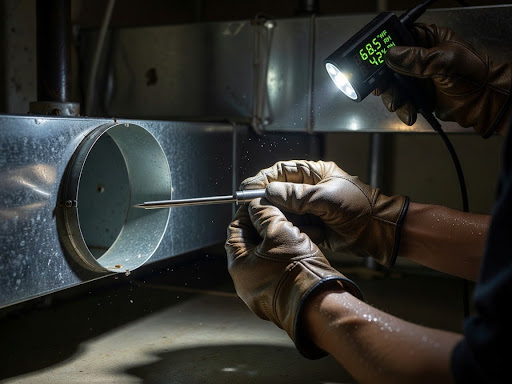
People conflate diagnosis with repair constantly, and it genuinely costs them money. A repair fixes something. A diagnostic tells you what needs fixing, and more critically, why. Skipping a proper diagnostic and jumping straight to part replacement is essentially guessing, except you’re the one paying for the guess.
The ac diagnosis process is closer to what a doctor does before writing a prescription. You wouldn’t want a physician to just hand you antibiotics without running tests first. The same logic applies when a technician is deciding whether your compressor needs replacing or whether the real culprit is a failed capacitor that costs $30. Those two scenarios carry wildly different price tags, and the only way to know which one you’re dealing with is through measurement, not intuition.
Consumer advocates consistently point out that homeowners receiving varying diagnoses for the same problem is often a sign that technicians are guessing rather than using documented performance data. That’s a real pattern, and it’s worth knowing before you open your door to any HVAC contractor.
Step-by-Step: What a Technician Should Actually Inspect
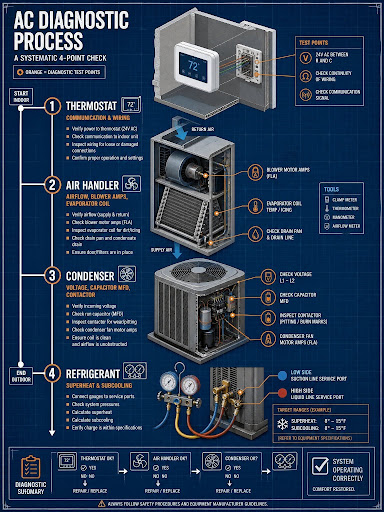
This is the section most companies don’t want to publish because it creates accountability. A thorough AC inspection process covers a lot of ground, and if your technician isn’t checking most of these items, you’re not getting a real diagnostic.
Starting at the thermostat, a qualified tech will verify that it’s communicating correctly with the air conditioning system, check for proper temperature calibration, and confirm that the wiring connections are intact. Interior thermostats get overlooked constantly, but a miscalibrated sensor inside the unit can mimic symptoms of a refrigerant problem or a failing compressor.
From there, the inspection moves to the air handler, where airflow gets measured, the blower motor is checked for amp draw, and the evaporator coil is visually inspected for ice buildup or biological growth. A frozen evaporator coil, for instance, can be caused by low refrigerant charge, a dirty filter, or a failing blower, and each cause points to a completely different repair path. You need data to tell them apart. A psychrometer measuring wet-bulb temperature at the return can give a technician meaningful insight into whether the refrigerant charge is the actual issue, as demonstrated in low refrigerant troubleshooting procedures used by certified HVAC professionals.
Outside at the condenser, a thorough tech runs electrical diagnostics using a multimeter to verify voltage at the disconnect, check capacitor microfarad (MFD) ratings against nameplate specs, and test the contactor for proper engagement. A diagnostic walkthrough of compressor no-start conditions shows just how systematically that process should work. Burnt wire insulation, weak capacitor readings, worn contactor pitting. These are visible, measurable problems, not theories.
Refrigerant pressure testing, performed only by EPA 608-certified personnel, uses manifold gauges to measure suction and discharge pressures. From those readings, a technician calculates superheat and subcooling values. This is where the science gets genuinely useful. Superheat that’s too high usually points to low refrigerant charge or a restricted metering device. Subcooling that’s off suggests an overcharge or a failing condenser coil. The procedure for checking superheat and subcooling is a core skill that separates a professional diagnosis from a visual estimate.
Other components a complete diagnostic covers:
- Condensate drain line for blockage (a leading cause of water damage in Florida homes)
- Fan motor operation and blade condition on the outdoor unit
- Safety controls including high-pressure and low-pressure cutouts
- Accessible ductwork for visible disconnections or collapse
- Overall system cycle, meaning the technician actually runs the unit through a full cooling cycle and observes real-world performance rather than just static checks
Modern systems also produce error codes. An F0 code, for example, typically signals a refrigerant leak, while E2 and E3 codes usually indicate indoor or outdoor sensor malfunctions. A technician who knows how to read these codes and cross-reference them with live readings is moving through a legitimate diagnostic process. One who ignores them is not.
How Long a Diagnostic Visit Takes
Expect most residential diagnostics to run somewhere between 45 and 90 minutes under normal conditions. Simple problems in accessible systems lean toward the shorter end. Older equipment with multiple symptoms, systems installed in tight attic spaces, or units that require refrigerant testing and full cycle observation can push the visit past two hours without any red flags.
When considering what does an AC technician check, it’s important to know that intermittent problems can be the hardest to diagnose. A system that only fails under certain temperature or humidity conditions may work normally during the appointment. In those cases, a qualified technician will explain the uncertainty rather than guess at the cause—a level of transparency that reflects thorough, professional service.
What the Diagnostic Fee Actually Covers
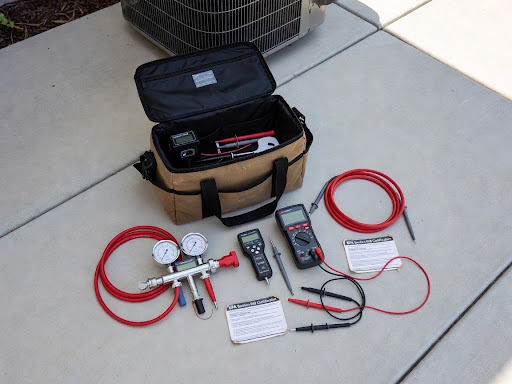
The diagnostic fee question makes homeowners uncomfortable, mostly because it feels like paying for information rather than a solution. But the fee covers real costs: the technician’s time, specialized diagnostic tools like manifold gauge sets and multimeters, electrical testing equipment, and the expertise required to interpret what those instruments are telling them. HVAC technicians in trade discussions have been vocal about why “free diagnosis” undervalues that expertise and actually encourages guessing over testing.
Industry ranges typically fall between $75 and $200 for a residential diagnostic, though that varies by region, system type, and company policy. Policies on whether the fee gets credited toward repairs differ by company, so ask that question directly before you schedule. Don’t assume.
| Diagnostic Fee Typically Covers | Usually Does Not Cover |
| System inspection and testing | Replacement parts |
| Electrical and refrigerant measurements | Labor for major repairs |
| Technician expertise and time | System replacement |
| Written findings or repair recommendations | Emergency after-hours premiums |
If you want context on what repairs themselves tend to cost once the diagnosis is complete, it helps to understand typical ac repair pricing before you’re standing in your driveway trying to evaluate a quote under pressure.
How to Tell If the Diagnostic Was Actually Thorough
Not every diagnostic visit delivers equal value, and homeowners deserve a realistic way to evaluate what they just received. A quality technician should explain findings in plain language without drowning you in jargon. They should show you the failed component when it’s physically safe and accessible to do so. Seeing a visibly burnt capacitor or a contactor with pitted contacts makes the recommendation real rather than abstract.
Watch for these signals:
- The technician runs the system through a full cycle rather than just a static visual check
- Readings are documented, not just verbally mentioned and then forgotten
- Repair options are presented with explanations, not ultimatums
- Questions get answered directly rather than deflected
- No pressure to approve repairs on the spot
Consumer resources that track common misdiagnoses specifically call out capacitors as parts that get replaced without sufficient justification. Ask the technician to show you the MFD reading from your capacitor against the nameplate spec. That’s a two-minute demonstration, and any professional should welcome the question. For deeper context on how six professional HVAC diagnostic methods actually apply in the field, it’s worth understanding the methodology before your visit.
Common Mistakes Homeowners Make Before and During the Visit
Skipping the conversation about maintenance history is probably the most expensive mistake. A technician who doesn’t know your system hasn’t been serviced in four years, that it froze up twice last summer, and that you replaced the capacitor eighteen months ago is working with incomplete information. Share that history upfront.
The second mistake is approving repairs before fully understanding what was found. A written summary of diagnostic findings, even a basic one, gives you a reference point if something goes wrong later or if you decide to get a second opinion. Speaking of which, getting two or three independent assessments before committing to a major component replacement, like a compressor or air handler, is widely recommended by consumer advocacy communities. The investment in a second diagnostic fee is almost always worth it when the repair quote climbs past a few hundred dollars.
Why Palm Beach Homeowners Work with Airfellows for Diagnostics
In a market where HVAC companies are abundant and trust is earned rather than assumed, Airfellows serves homeowners across Palm Beach, Palm Beach Gardens, Jupiter, and North Palm Beach with licensed, insured technicians who approach every diagnostic visit as a documentation exercise, not a sales call. The AC diagnostic process follows the kind of structured inspection described throughout this guide, with findings communicated clearly before any repair discussion begins.
Transparent communication before approving work is the standard, not the exception. If you want to understand what the entire service appointment looks like from arrival to completion, seeing what to expect during a professional repair visit gives you that full picture ahead of time.
Frequently Asked Questions
How much does an AC diagnostic fee cost?
Fees vary by company, geographic market, system type, and what the diagnostic actually includes. Broad industry ranges fall between $75 and $200 for standard residential systems. Some companies credit the diagnostic fee toward approved repairs; others don’t. That policy question is worth asking before you book rather than after the visit.
How long does an AC diagnostic take?
Most residential diagnostics run 45 to 90 minutes. Systems with multiple symptoms, older equipment, or units that need refrigerant testing and a full observed cooling cycle can extend that to two hours or more. Intermittent problems that don’t replicate during the visit are genuinely difficult to diagnose and a trustworthy technician will say so directly.
Is the diagnostic fee applied to the repair?
Some HVAC companies apply the diagnostic fee as a credit toward any repairs you approve during the same visit. Others treat it as a separate, non-refundable service charge. There’s no universal standard, so confirm the company’s specific policy before scheduling. It’s a reasonable question and a professional company will answer it without hesitation.
Good repairs begin with good diagnostics, and that’s not a slogan, it’s practical logic. A thorough air conditioning system diagnostic reduces the risk of replacing parts that weren’t actually failing, gives you documented evidence for warranty claims or second opinions, and puts you in control of a conversation that can otherwise feel very one-sided. Ask questions. Request documentation. Understand the findings before you approve anything. Schedule a diagnostic with Airfellows when you’re ready for an inspection built around transparency rather than assumptions.