
When considering AC repair vs replacement, many homeowners reach the same crossroads: you get the repair estimate and wonder whether is it worth fixing an old AC or if it’s finally time to replace it. It’s a common decision, especially as repair costs climb, and the right choice depends on factors like your AC’s age, the extent of the problem, energy efficiency, and the cost of future repairs.
Every Palm Beach homeowner eventually hits that crossroads, and the frustrating reality is that neither “just repair it” nor “just replace it” is automatically the right answer. The cheapest fix today can quietly become the most expensive decision over the next five years. But spending $8,000 on a brand-new AC unit when a $400 part would’ve solved everything? That’s its own kind of painful.
Airfellows helps Palm Beach homeowners make this decision with a straightforward approach. Rather than pushing the more expensive option, this guide explains how your system’s age, repair cost, energy efficiency, and overall reliability work together to determine whether repairing or replacing your AC makes the most sense.
The Four Questions That Usually Decide the Answer
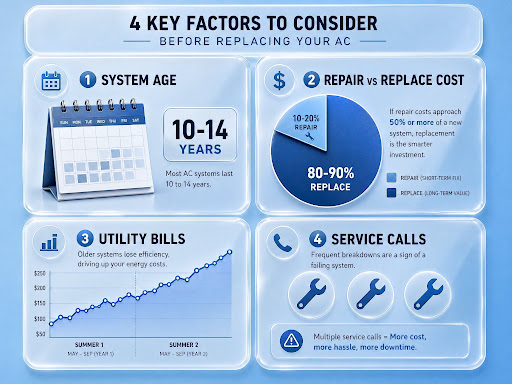
Before diving into the granular stuff, there’s a short-circuit method that cuts through a lot of the noise. Most homeowners who feel stuck on the repair-or-replace question haven’t asked themselves four pretty basic things in sequence.
- How old is the AC system?
- What’s the actual repair cost relative to a replacement?
- Has the utility bill been creeping up over the last two summers?
- How many service calls has this unit needed in the past two or three years?
The reason these four questions matter so much is that they represent different categories of risk: financial risk, operational risk, and the kind of quiet, slow-burn cost that doesn’t show up in a single invoice but absolutely shows up in your bank account. Answer them honestly and you’ll already be 80% of the way to a decision.
Factor #1: The Age of Your AC System
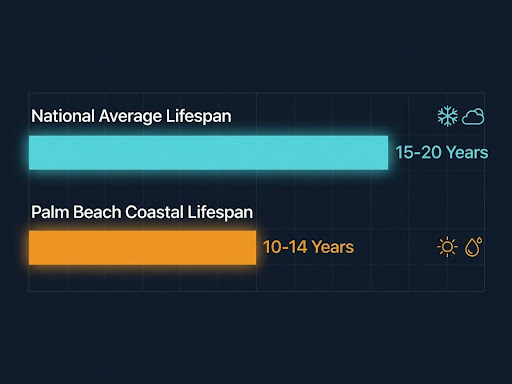
In most parts of the country, a well-maintained central AC system lasts somewhere between 15 and 20 years, according to lifespan guidelines. Palm Beach County is not most parts of the country. The combination of intense heat, near-constant humidity, and a cooling season that stretches from April all the way through October puts HVAC systems here under stress that homeowners in, say, Minneapolis simply don’t experience. In practice, that 15-to-20-year window often compresses to 10 to 14 years for systems that haven’t been consistently maintained.
So where does your unit fall?
Under 8 years old, and a repair is almost always the right call, assuming it isn’t something catastrophic like a failed compressor on a system that’s already had two or three major fixes. Between 8 and 12 years, it starts to depend on the other factors. In that 12-to-15-year range, you’re entering territory where replacement deserves serious consideration, not because the unit can’t survive another repair, but because you’re getting close to a point where the money spent keeping it alive stops making sense. Once a system is past 15 years, Consumer Reports is fairly direct: start planning for a replacement, because aging systems lose efficiency and lack the filtration technology found in modern units.
One thing worth mentioning separately: if your AC system runs on R-22 refrigerant, the calculus changes immediately. R-22 has been phased out under EPA regulations governing ozone-depleting substances, which means it’s increasingly scarce and expensive to source. A refrigerant leak on an R-22 system isn’t a $200 fix anymore. It can run several times that, and you’re still left with an aging system that’ll need the same conversation again next summer.
Age alone shouldn’t trigger replacement. A 13-year-old unit that’s been well-serviced, runs clean, and has only needed minor repairs is a different animal than a 13-year-old unit that’s been neglected and patched together three times.
Factor #2: Repair Cost vs. Replacement Cost
This is where homeowners tend to either overthink or drastically underthink. The raw numbers matter, but the relationship between them matters more.
Full HVAC replacement in 2026 typically ranges from $5,000 to over $20,000 for residential systems depending on the size of the home, the equipment tier, and installation complexity, per recent cost data from CBS News. A compressor replacement alone can run anywhere from a few hundred dollars to well over $2,000 depending on system type, as detailed breakdowns of 2026 compressor repair costs show. Smaller component repairs, like a contactor swap or a blower motor, tend to fall in a much lower range and are generally straightforward.
The 50% rule, which Consumer Reports and several housing analysts have long recommended, gives you a clean starting point: if the repair cost exceeds 50% of what a new system would cost, that money is better applied toward replacement. So if a new unit runs $6,000 and you’re looking at a $3,200 repair quote, you’re essentially past the threshold.
| Repair | Replacement | |
| Upfront cost | Lower | Higher investment |
| What it does | Extends current system | Starts fresh |
| Future repairs | Likely, especially on older units | Minimal early on |
| Efficiency impact | Usually unchanged | Typically improved |
| Warranty | Depends on part/labor terms | Often 10-year manufacturer warranty |
The part that a lot of people miss is the frequency factor. One $600 repair on a healthy system is a non-event. Three $600 repairs in 18 months is a pattern, and that pattern is telling you something about where the system is headed. I’ve seen homeowners in Jupiter and Palm Beach Gardens talk themselves into repair after repair because each individual bill seemed manageable, only to add it all up and realize they’d spent near-replacement money while still owning an aging, inefficient unit. That’s the trap.
If you want a gut check on what repairs should actually cost before committing, reviewing transparent pricing upfront saves a lot of the guesswork.
Factor #3: Energy Efficiency and Monthly Utility Bills
Florida’s cooling season is long. Brutally, relentlessly long. That matters financially in a way that doesn’t apply to homeowners who only run their AC four months a year, because every efficiency point you’re losing gets multiplied across ten or eleven months of continuous operation.
Older AC systems are rated using older SEER (Seasonal Energy Efficiency Ratio) standards, and many pre-2010 units run at SEER ratings that today’s 2026 SEER2 regional minimum standards have made essentially obsolete for new installations. The practical consequence is that if your utility bills have been climbing even though your usage habits haven’t changed, the system’s degrading efficiency is likely a significant contributor. Energy Star’s replacement guidance specifically flags systems older than 10 years as candidates for upgrade on efficiency grounds alone.
A new high-efficiency system can reduce monthly cooling costs by 25% to 40% depending on how inefficient the old unit was, which over a decade of Palm Beach summers adds up to a number that justifies a lot of upfront investment. That’s not marketing language. I ran the numbers on a 14-year-old unit being swapped for a modern variable-speed system and the ongoing savings were substantial enough to offset the replacement cost within six to eight years, and that didn’t even account for the federal tax credit that qualified buyers can claim under the Inflation Reduction Act’s HVAC incentives, which offers up to $600 for qualifying AC units or $2,000 for heat pump systems.
Beyond the bill itself: humidity control and air quality improve significantly with newer HVAC systems, which matters in a place like North Palm Beach where the air is thick and mold risk is real.
Factor #4: Reliability and Peace of Mind
There’s a version of this question that pure cost analysis doesn’t fully capture, and it’s the one Palm Beach homeowners feel most viscerally in July: what is an unreliable AC system actually costing you in stress, disruption, and emergency service calls?
A system that’s broken down twice already this season isn’t just an expense. It’s a liability. Emergency HVAC failures in hot, humid climates can deteriorate indoor air quality quickly, create moisture problems, and in homes with elderly residents or young children, become a genuine safety concern within hours. When you start factoring in the premium rate of same-day or emergency service calls on top of the actual repair cost, the economics of keeping an unreliable unit running look considerably worse.
Repeated breakdowns are one of the clearest signals that a system is past its practical lifespan, even if individual repairs seem manageable in isolation. If you’ve called for service three or more times in a two-year span, that frequency alone is reason to reconsider.
The $5,000 Rule: A Helpful Guideline, Not a Guarantee
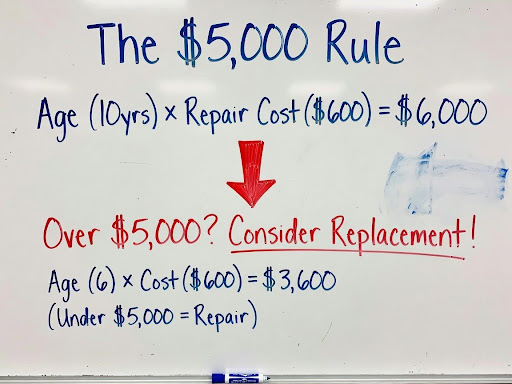
Several HVAC manufacturers, including Trane and Lennox, have popularized what’s often called the “$5,000 Rule” as a quick framework for thinking about long-term costs. The formula is simple: multiply the system’s age in years by the cost of the repair. If the result exceeds $5,000, the guidance leans toward replacement.
A worked example: a 10-year-old system facing a $600 repair. $600 times 10 equals $6,000, which clears the threshold. A 6-year-old system with the same $600 repair? $3,600, which falls under it.
It’s genuinely useful as a first-pass filter. The caveat worth stating clearly is that it’s a rule of thumb, not an industry standard or a guarantee of anything. A system that scores $4,800 by this formula but has had three breakdowns in the past year and runs at a low SEER rating is arguably a stronger replacement candidate than a $5,200 system that’s been well-maintained and runs efficiently. The formula doesn’t know about your unit’s service history, refrigerant type, or actual performance, so treat it as one input among several, not a verdict.
Common Mistakes Homeowners Make
When asking, should I repair or replace my AC, it’s important to avoid a few common decision-making mistakes. Homeowners often focus only on the immediate repair cost while overlooking factors like the system’s age, overall condition, energy efficiency, and the likelihood of future breakdowns. Looking at the full picture leads to a more informed and cost-effective decision.
- Choosing based only on the upfront number, without accounting for recurring repair frequency or efficiency losses compounding over time.
- Automatically assuming an older system needs replacement, when a well-maintained 12-year-old unit with a minor fault might have several solid years left.
- Continuing to repair a chronically unreliable system because each individual bill feels tolerable, without stepping back to count the cumulative total.
- Waiting until complete failure to make a decision, which forces a rushed choice, often in peak season when contractor availability is tight and premium emergency rates apply.
One more I’d add from experience: not vetting the contractor doing the diagnosis. A legitimate HVAC assessment should include a clear explanation of what failed, why it failed, how long the repair is expected to hold, and what the next likely failure point would be. If you’re getting a repair quote with no context, or a replacement recommendation with no load calculation (what HVAC professionals call a Manual J), that’s a red flag worth paying attention to.
When Repair Makes Sense, and When Replacement Is the Better Choice
Pulling it all together:
Repair tends to be the right move when the system is under 10 years old, the repair is a single, isolated fault of moderate cost, the unit has been reliable, and your efficiency isn’t noticeably degraded. Angi’s home services guidance specifically supports repairing equipment under 10 years old, especially for minor faults still under manufacturer warranty.
Replacement tends to make more sense when the system is 12 or more years old, has required multiple repairs in a short period, uses R-22 refrigerant, is visibly losing cooling performance, or when the repair cost clears the 50% threshold relative to a new system. If you plan to stay in the home long-term, a new high-efficiency system becomes an even easier case, especially with current federal incentives available. For homeowners selling within two or three years, Reddit’s homeowner communities and housing analysts generally favor a modest repair over full replacement, since the ROI on a new system compresses significantly in a short ownership window.
Get an Expert Assessment Before You Decide
Every home is different. A blanket recommendation to repair or replace without actually looking at your specific system, your service history, and your household’s needs isn’t advice, it’s a guess. The framework in this guide gets you most of the way there, but a proper diagnosis from a qualified HVAC contractor removes the remaining guesswork. That assessment should include a clear breakdown of what’s wrong, realistic expectations for how long a repair will hold, and honest efficiency data so you can make the comparison with real numbers in hand. Whether the answer is a targeted repair or a full AC replacement, the right call is the one that makes sense for your home, not just the one that’s easiest to sell.
FAQs
When should I replace instead of repair my AC?
When the system is over 12 years old, has needed multiple costly repairs recently, runs on outdated refrigerant, or when the repair cost exceeds 50% of a new unit’s price. Poor efficiency and persistent comfort issues in homes around Palm Beach and Jupiter are also strong signals.
Is it worth repairing a 15-year-old AC?
Rarely, but it depends. If the repair is minor, the system has been consistently maintained, and performance is still acceptable, a small fix might buy a useful amount of time. More often, a 15-year-old unit in Palm Beach County’s climate is near the end of its practical life, and repair money at that stage tends to be short-term relief rather than a real solution.
What’s the $5,000 Rule for AC repair?
Multiply the system’s age in years by the dollar cost of the repair. If the result exceeds $5,000, industry guidance generally favors replacement. It’s a useful starting point, but not a substitute for a full assessment that accounts for efficiency, reliability, and actual condition.